The ONLY active voice for American Arab Journalists.

Sunday, September 03, 2006

Ron Grossman's gross distortion of the Muhammad Salah case

Ron Grossman whitewashes the Salah persecution
By Ray Hanania

Ron Grossman is a reporter for the Chicago Tribune who has built his name not just on writing long features, but on exploring his Jewish identity and love for Israel.

The Middle East conflict is a longstanding war between Palestinian Arabs and Jews from Europe, the Middle East and even the United States.

Can a Jewish journalist with deep passions not only for his religion but also Israel write objectively about a case so nuanced as the political persecution of Mohammed Salah?

When you read Grossman’s lengthy perspective on the Salah case, the answer is "No."

This isn’t about being Jewish. It is about whether a journalist can be objective when the topic he writes about is so tainted by his personal biases. Can you imagine the uproar in the highly unlikely event that the CHicago Tribune would have allowed a Palestinian journalist to write on the same topic?

Yet Grossman penned an exhaustive report on Salah dripping with subtle pro-Israel references that not even a supporter of Salah could recognize him as being the obvious victim of Israeli torture who survived the Israeli Gulag only to face trumped up charges that will land him in the American prison Gulag.

First among Grossman’s flaws is his reporting that Salah was arrested by Israel and accused of supporting Hamas, an organization Grossman casually notes was designated by the United States as a terrorist organization too.

Of course, Grossman fails to point out that the designation of Hamas as a terrorist organization did not come until almost three years later. In fact, that designation took place in 1995 and then officially detailed in a State Department report in 1997, partly in response to Hamas's resistance to the Olso Peace Accords. It was a political move. (Read 1997 designation story?) (Read 2003 supplemental report?)

But that's not all.

The fact is that Hamas did not turn to Suicide bombing as a weapon of resistance against Israel’s oppressive military occupation until May 1994, more than one year after Salah was illegally detained and made into a political prisoner when he was arrested by Israel’s secret service in January 1993.

The suicide bombing that took place in Afula was the direct result of the terrorism that took place a months before in Hebron when a prominent Jewish Chicagoan who maybe Grossman knew, walked into a Mosque in Hebron and gunned down 29 Palestinians while they were in prayer.

OUT OF ISRAELI PROPAGANDA

Most disgusting is Grossman’s gross attempt to whitewash Israel’s role in persecuting Palestinians and undermining Salah’s only hope for acquittal in the Federal prosecution now pending before him.

Grossman writes two passages at the very end that pack a powerful biased punch that read as if they came right out of a Shin Bet torture handbook to counter Palestinian claims they are victims of Israeli persecution, illegal imprisonment, prison torture, military abuse and even murder.

Grossman fires an Israeli dart through the heart of Salah’s defense, his only chance at acquittal in the biased, anti-Arab American courtroom:

To deprecate Salah’s defense that he was the victim of torture or that he was supporting a legitimate effort to cast off Israel’s brutal occupation, Grossman speculates that Salah’s defense attorney is basically arguing that might Salah’s case can be compared to the fight Americans waged against the British during the Revolutionary War.

And then Grossman stabs the argument in the back, writing in the very last paragraph of the Tribune magazine feature:


"So Mr. Salah," he [Salah’s defense attorney] might ask. "Do you mean to tell these jurors there’s no difference between Patrick Henry and a suicide bomber?"
Grossman’s writing here is a disgusting revelation into a hatred of the Palestinians. His feature in the Sunday magazine of the Chicago Tribune is an undisguised effort to smear Salah’s case.

Yes, if Salah was a foot soldier against Israel he had every right to fight the occupation as a resistor. He had every right to defend himself against Israeli military terrorism that has been documented by Amnesty International and many other Israeli and Arab and European agencies.

Yes, if Salah was some high-up member of Hamas, an organization that traces its roots back to Israel’s political efforts to create an alternative to the PLO. Israel did everything it could to help Sheik Ahmad Yassin found the Islamic Association in the 1970s in the Gaza Strip believing that a religious movement that put religion about Palestinian nationality might help to undermine the PLO and its leader Yasser Arafet.

Grossman acknowledges this fact in a wimpy passage that downplays the fact that if Hamas is a monster terrorist organization that Israel claims, it is Israel’s Frankenstein. Hamas and Hamas terrorism is the result of Israel’s making, caused by Israel’s terrorism against the Palestinians for more than half a century.

Ironically, an American-made Israel fighter jet fired a missile and killed Yassin as he was leaving prayers at a Gaza Mosque in his wheelchair. The murder of the paraplegic didn’t move Grossman to lambaste Israeli terrorism, even though that killing also took the lives of about nine civilians who happened to be standing nearby when Yassin was murdered.

And, when rereading much of what Grossman has penned lovingly about Israel, jadedly about Palestinians, you find that he heaped praise on the author of a book that celebrated the life of Barney Ross, a Jewish American boxer who, after serving in World War II sought to run guns and enlist from his U.S. Marine colleagues a resistance to fight in Palestine against the British and the Palestinian Arabs.

Ah, but Barney Ross is Jewish and he therefore has a right to run guns and resist British occupation.

Salah, on the otherhand, is a Palestinian Muslim and he has no right to resist occupation and help his people’s cause for justice and liberation.

ISRAELI AND AMERICAN GULAG

Salah has argued to all who would listen – objectively – that he was imprisoned by the Israelis simply because he was stopped with money in his possession. Not hundreds of thousands as has been inaccurately reported but with about $97,000.

Every Palestinian knows that Israel will not allow Palestinians outside of the territories they occupy illegally to funnel money to their family friends and even their organizations, most of which were founded to build up activism against Israel’s occupation.

Occupations just don’t go away. They have to be pushed out. And that "pushing" can often be described by the oppressors – Israel – as "terrorism."

Almost every point Grossman tries to make is skewered towards strengthening Israel’s argument while underming Salah’s argument.

Another pathetic reference is made to Judith Miller, the lying cheating reporter who was exposed at the New York Times. Miller was brought in by the Israeli Shin Bet when Salah was being tortured to document his comments so she could then use the information, distort it into pro-Israel propaganda, and then use it in her campaign to undermine the Palestinians in the United States.

As it turns out, Miller’s reputation as an unethical journalist was exposed in the case involving the CIA wife of a White House aide who exposed President Bush’s lies about Iraq. Valery Plame’s cover was later blown intentionally by Bush’s underlings as punishment and Miller found herself neck deep in the journalism scandal.

Yet Grossman references Miller as if she were the champion of justice that too many American journalists, including Grossman, fail to be when the focus of their writing happens to be Israel.

Ron Grossman’s article on Salah is political. Rather than being an insightful look into a complicated case, it is clearly an effort to tilt the case towards Israel’s claims. Grossman even dilutes the accusations that Salah was the victim of torture.

If what happened to Salah was done to American soldiers imprisoned by any other country, we would be screaming that the harassment, sleep depravation for more than 53 days and more. He was placed in a cell with other hardcore members of Hamas who suspected he was a plant and naturally, one might want them to believe they were Hamas supporters in the struggle against Israel.

Muhammad Salah is a political prisoner who was tossed around for five years after he was forced to confess to being a Hamas supporter in the Israeli Military prison Gulag, where Palestinians are routinely tortured and forced to sign confessions that in any other court of law would be tossed out as worthless.

Now, he sits under the hail of lies and faces more time in the American prison Gulag as his case is distorted and twisted in a pro-Israel judicial system that has little concern about laws and more concern for political outcome.

Salah will never get a fair trial in our judicial system.

But I am most disappointed, but not surprised, that Salah can’t get a fair trial in the pro-Israel American news media.

(Ray Hanania is an award winning journalist and author. He can be reached at www.hanania.com.)

Tuesday, August 29, 2006

Israeli missiles strikes intentionally target and injure Reuters journalists in Gaza

In Gaza, Israeli missile strikes Reuters vehicle and wounds two

Committee to Protect Journalists
330 Seventh Avenue, New York, NY 10001 USA Phone: (212) 465‑1004 Fax: (212) 465‑9568 Web: www.cpj.org E-Mail: media@cpj.org
http://www.cpj.org
Contact: Abi Wright
e-mail: mideast@cpj.org
Telephone: (212) 465-1004 x-105

New York, August 28, 2006—The Committee to Protect Journalists is alarmed by the apparent targeting of two Palestinian cameramen by Israeli forces in Gaza City late Saturday. A missile struck their armored car in the densely populated Shijaiyah neighborhood, seriously wounding Fadel Shana, a freelance cameraman for Reuters, and Sabbah Hmaida, a cameraman with a private Palestinian TV facilities house, Media Group.

Reuters said the vehicle was clearly marked “Press” on all sides. The missile struck the letter “P” of the bright red “Press” sign on the car’s roof, the news agency added. Shana lost consciousness for several hours and suffered shrapnel wounds in his right hand and leg, Reuters reported. Hmaida sustained serious leg wounds from shrapnel.

Shana had rushed out to film a suspected Israeli air strike. He was about 1,300 yards (1,200 meters) from the nearest Israeli soldiers when the vehicle was struck, Reuters reported.

“We condemn this missile strike on a vehicle that was clearly identified as press,” said CPJ Executive Director Joel Simon. “The Israeli military must investigate this attack and hold those responsible accountable.”

An Israel Defense Force (IDF) spokesperson said the car had aroused suspicion because it was near soldiers in a combat area at night, Reuters reported. “This car was not identified by the army as a press vehicle,” army spokeswoman Capt. Noa Meir told Reuters. “If journalists were hurt, we regret it.”

The Foreign Press Association (FPA) in Israel called the attack an “outrageous targeting” and demanded a full investigation, adding, “there is a serious risk that relations between the FPA and the IDF will be significantly damaged.”

Other allegations of deliberate targeting of journalists covering fighting in Gaza and south Lebanon have been made against the Israeli army over the past two months. On July 27, Palestine Television cameraman Ibrahim al-Atla was seriously wounded by an Israeli tank shell during a lull in shooting between Palestinian militants and Israeli forces in Shijaiyah.

In Lebanon, crews from four Arab television stations told CPJ that Israeli aircraft fired missiles within 80 yards (75 meters) of them on July 22 to prevent them from covering the effects of Israel’s bombardment of the area around the town of Khiam, in the eastern sector of the Israel-Lebanon border.

CPJ is a New York–based, independent, nonprofit organization that works to safeguard press freedom worldwide. For more information, visit www.cpj.org.

Monday, August 28, 2006

NAAJA at SPJ Annual Convention in Chicago with photos

Arab-Jewish comedy highlights Journalists ConFab
Arab American Media Syndication

(Chicago/August 28, 2006) -- The Holy Land Comedy Tour performances of Jewish American Comedian Aaron Freeman and Palestinian partner Ray Hanania were featured this year at the annual convention of the Society of Professional Journalists.


Hanania also manned a booth at the SPJ Convention on behalf of the National Arab American Journalists Association and worked with a handful of Arab and Muslim journalists to lobby mainstream reporters to "report smart" on the American Arab and Muslim community.


"If we want to correct the flaws that exist in American mainstream journalism, we have to be at the frontline in every way from addressing serious issues to also engaging in more subtle ways to change negative perceptions that are written in American stones," Hanania said.


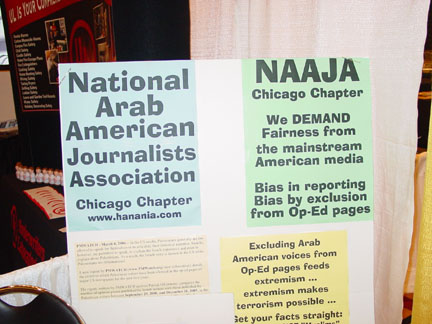
More than 600 professional journalists from around the country attended the four day convention at the Hyatt Regency Hotel in Chicago. NAAJA’s booth featured fact sheets on the Middle East, Arabs, Muslims and political issues, and distributed copies of the best Arab American newspapers and magazines from around the country. NAAJA volunteers also distributed copies of resumes to editors and publishers on behalf of about 15 Arab American journalists.


NAAJA has several chapters that are in formation and works closely as a caucus with the Asian American Journalists Association. Hanania serves on the AAJA Media Monitoring Committee which challenges unprofessional references to Asians, Arabs and Muslims in the mainstream media.


NAAJA remains in contact with about 147 Arab Americans working fulltime in either mainstream American journalism positions, or in the Arab American ethnic media for newspaper or magazines. There are about 70 Arab American newspapers and magazines, according to NAAJA records that are updated each month.


"The convention attendees were very interested in obtaining contact information for editors and publishers at Arab American media because these editors and publishers can be their best and most reliable sources," Hanania said.


"The biggest complaint I heard from mainstream journalists is that they cannot find reliable resources, sources or community representatives and no one is more representative or reliable than the publisher, editor or reporter for a quality Arab American newspaper or magazine."


Hanania noted that "The biggest complaint I heard from Arab American journalists who attended the SPJ Conference is that they are targeted by hate groups like Little Green Footballs, MilitantIslam.com, Daniel Pipes and other anti-Arab hatemongers simply because they happen to be Arab American or Muslim and they have very few resources to turn to in order to counter the pressure often exerted on their media employers.


"Arab American journalists need support. The reason we are targeted is that these anti-Arab and anti-Muslim hate groups know that if we enter the mainstream journalism system and press for true professionalism, the coverage of the Middle East will change from the one-sided bias that it is today," Hanania said.


Now celebrating his 30th year in Journalism, Hanania has won two SPJ Chicago Headline column writing awards and two Chicago Newspaper Guild column writing awards. He entered standup comedy after Sept. 11 and performs for Arab, Jewish and mainstream American audiences across the country appearing on the Today Show, Good Morning America, CNN, NPR and at such clubs as Carolines on Broadway and the New York Comedy Club.


Hanania partnered with Aaron Freeman and Sandy Shea to perform the hit comedy show "The Holy Land Comedy Tour." Information on their show is available at www.AaronFreeman.com or www.hanania.com.

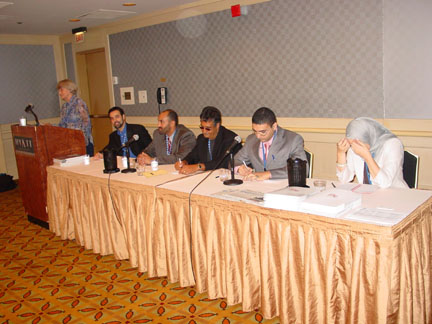
The SPJ Convention also featured a panel discussion on "Improving Coverage of Arab and Muslim Communities" that included Chicago CAIR Director Ahmad Rehab, Islamica Magazine Senior Editor Firas Ahmad, Columnist and author Hesham Hassaballa, MPAC Communications Director Edina Lekovic, NAAJA activist Ray Hanania and moderator Doris Norrito of the Tampa Bay Weekly Newspapers.

Ahmad spoke about the need to add greater "depth of coverage" to the Arab and Muslim community by expanding beyond politics to include more social and cultural events. Rehab said that journalists must seek a broader understanding of the communities they cover and "do their leg work."

PHOTOS:


An Arab journalists stops by to say hello and get resource and network information.


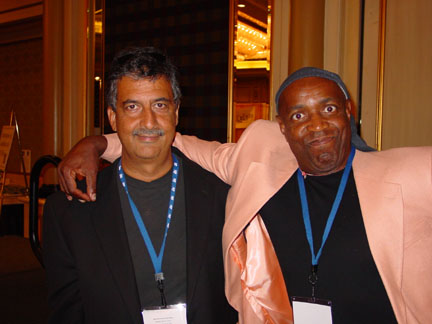
Ray Hanania and Aaron Freeman


Materials at the NAAJA booth


Panel: discussion on "Improving Coverage of Arab and Muslim Communities" that included Chicago CAIR Director Ahmad Rehab (2nd right), Islamica Magazine Senior Editor Firas Ahmad (2nd left), Columnist and author Hesham Hassaballa (3rd left), MPAC Communications Director Edina Lekovic (right), NAAJA activist Ray Hanania (3rd right) and moderator Doris Norrito of the Tampa Bay Weekly Newspapers (left).

END

NAAJA Urges Sudan to release Journalist

The National Arab American Journalists Association called on the Government of Sudan to drop charges against a prominent American journalist accused of spying.

Paul Salopek, a two-time Pulitzer Prize-winning foreign correspondent for the Chicago Tribune, was charged with espionage and two other criminal counts in a Sudanese court Saturday (August 26, 2006) , three weeks after he was detained by pro-government forces in the war-torn province of Darfur, according to the Chicago Tribune Sunday.

Salopek, 44, was on a freelance assignment for National Geographic magazine, the newspaper wrote, when he was arrested with two Chadian nationals, his interpreter and driver. If convicted, they could be imprisoned for years.

"Salopek is a highly regarded journalist and that achievement must be weighed when considering his fate. The National Arab American Journalists Association urges the Government of Sudan to recognize Salopek for what he is, a professional journalist seeking to report on a story," said NAAJA Chicago Chapter organizer Ray Hanania.

Salopek was on a scheduled leave of absence from the Tribune when he and the two Chadians were detained Aug. 6 and jailed. All three were officially charged this past week with espionage, passing information illegally and writing "false news," in addition to a violation of Sudan's immigration laws by entering the country without a visa.

Salopek was on assignment to write an article on the sub-Saharan African region known as the Sahel for National Geographic, a prestigious magazine that has a proven record of balanced and rich reporting on Middle East countries, culture and events.

NAAJA urges its members to write on this topic and urge the Sudanese government to respect the rights of journalists and respect the facts which suggest that Salopek is not a spy but a dedicated and proven professional journalist trying to do his job.

END

Tribune reporter held in alleged spy case in Sudan

Tribune correspondent charged as spy in Sudan

Paul Salopek, 2-time Pulitzer winner, was on freelance assignment for National Geographic
By Tim Jones
Tribune national correspondent
Published August 26, 2006, 4:54 PM CDT

Paul Salopek, a two-time Pulitzer Prize-winning foreign correspondent for the Chicago Tribune, was charged with espionage and two other criminal counts in a Sudanese court Saturday, three weeks after he was detained by pro-government forces in the war-torn province of Darfur.

Salopek, 44, who was on a freelance assignment for National Geographic magazine, was arrested with two Chadian nationals, his interpreter and driver. If convicted, they could be imprisoned for years.

Chicago Tribune Editor and Senior Vice President Ann Marie Lipinski called Salopek "one of the most accomplished and admired journalists of our time. He is not a spy."Our fervent hope is that the authorities in Sudan will recognize his innocence and quickly allow Paul to return home to his wife, Linda, and to his colleagues," Lipinski said. She added: "We are deeply worried about Paul and his well-being, and appeal to the government of Sudan to return him safely home."

Salopek was on a scheduled leave of absence from the Tribune when he and the two Chadians were detained Aug. 6 and jailed. All three were officially charged Saturday with espionage, passing information illegally and writing "false news," in addition to a violation of Sudan's immigration laws by entering the country without a visa.

A judge in El Fasher, the capital of North Darfur state in western Sudan, granted a defense motion for a continuance, delaying the start of the trial until Sept. 10.

The hearing lasted about 40 minutes before the judge granted the continuance.In the week since editors at the Tribune and National Geographic learned of the arrest of the three men, they and others have protested and worked through political and diplomatic channels in the U.S. and overseas to secure their release.Chris Johns, National Geographic's editor in chief, said Salopek was on assignment to write an article on the sub-Saharan African region known as the Sahel.

"He had no agenda other than to fairly and accurately report on the region," Johns said. "He is a world-recognized journalist of the highest standing, with a deep knowledge and respect for the continent of Africa and its people."

Salopek has been in telephone contact with National Geographic and Tribune editors and earlier this week was visited by a congressional delegation led by U.S. Rep. Christopher Shays (R-Conn.).

"Paul did a very foolish thing coming into the country without a visa and he knows that," Shays said in an interview Saturday. " . . . He knew he made a mistake. But it's not in anybody's interest--in their or our governments--to have this blown out of proportion. This is a reporter doing what reporters do. They don't have any designs against the government. They're just reporting what they see."

The charges come amid increasing signs that diplomatic efforts to resolve the continuing crisis in Darfur are failing. Assistant Secretary of State Jendayi Frazer, who has called the situation in Darfur dire, is leading a mission that she hopes will persuade the Sudan government to accept an expanded United Nations peacekeeping force in Darfur.

The presiding judge in Salopek's case on Aug. 14 sentenced Slovenian writer and activist Tomo Kriznar to two years in prison on charges of spying and publishing false information. Kriznar admitted entering the country without a visa but denied the spying charge. His attorneys are appealing.Earlier this month, the same judge ordered the deportation of an American who the U.S. embassy described as a college student doing research when detained.

Salopek, who has extensive experience reporting from Africa, had been traveling in Chad, near the Sudanese border. When arrested, Salopek was carrying two U.S. passports--a legal practice, common among journalists and other frequent travelers who require multiple visas--and satellite maps of the conflict zone in Darfur, printed from public Web sites. According to sources, Sudanese officials view the passports and maps as evidence of espionage.

National Geographic became concerned when Salopek failed to show up at a long-scheduled appointment Aug. 17. His last contact with his wife had been Aug. 5.

During Saturday's hearing, the judge allowed reporters and photographers in the courtroom. Omer Hassan, defense attorney for the three men, argued they could not get a fair trial because of prejudicial remarks reported in the media by the governor of North Darfur. Specifically, the governor called Salopek a criminal. The judge ordered that such remarks stop.Hassan sought a trial delay of three weeks; the judge ordered a two-week continuance.

Salopek, who appeared gaunt, spoke briefly during the hearing, reciting his name, age and marital status.Salopek's arrest is one more case in an international trend of charges against journalists. A Beijing court on Friday dismissed a state secrets charge against a researcher for The New York Times but sentenced him to three years in prison on a lesser, unrelated fraud charge.

Salopek spent several years as the Tribune's bureau chief in Johannesburg. His 2001 Pulitzer for International Reporting recognized his work on the continent, including his coverage of the civil war in Congo. The Pulitzer board cited Salopek "for his reporting on the political strife and disease epidemics ravaging Africa, witnessed firsthand as he traveled, sometimes by canoe, through rebel-controlled regions of the Congo."

Salopek had reported from Sudan for a 2003 National Geographic story entitled "Shattered Sudan: Drilling for Oil, Hoping for Peace." He also co-wrote a piece from Africa for National Geographic in September 2005, entitled "Who Rules the Forest?" which examined the effects of war in Central Africa.Sudan has been racked by civil war for decades. Northern and southern Sudanese leaders signed a peace agreement in January 2005, but that has done nothing to end strife in the western region known as Darfur.

The rebels in Darfur, mostly black African farming tribes, have been fighting the country's Arab-dominated central government. The government has used an Arab militia called the janjaweed to attack rebels and ordinary villagers in Darfur, causing 2 million people to flee their homes and leading to the deaths of more than 180,000, many from disease and hunger.

The Sudanese government tightly controls access to the region, more than 500 miles west of Khartoum.Salopek, a California native, joined the Tribune in 1996 and has covered Africa, the Balkans, Central Asia and the wars in Afghanistan and Iraq. Before his 2001 Pulitzer, he won a Pulitzer in 1998 for explanatory reporting for his coverage of the controversial Human Genome Diversity Project.

Before joining the Tribune, Salopek worked as a writer for National Geographic for three years. Before that, he reported on U.S.-Mexico border issues for the El Paso (Texas) Times. In 1990, he was Gannett News Service's bureau chief in Mexico City.Salopek's most recent work for the Tribune was a July 30 special section called, "A Tank of Gas, a World of Trouble."

Based on Salopek's reporting from four continents, the report documented the United States' addiction to oil.

end

Sunday, August 27, 2006

US Arrests satellite distributor for including Hezbollah TV Station

New Yorker arrested for broadcasting Hizbollah TV

U.S. authorities have arrested a New York man for broadcasting Hizbollah television station al-Manar, which has been designated a terrorist entity by the U.S. Treasury Department, prosecutors said on Thursday. Javed Iqbal, 42, was arrested on Wednesday because his Brooklyn-based company HDTV Ltd. was providing New York-area customers with the Hizbollah-operated channel, federal prosecutors said in a statement.It did not say how long Iqbal's company had been providing satellite broadcasts of al-Manar, which the U.S. Treasury Department in March had designated as Specially Designated Global Terrorist entity, making it a crime to conduct business with al-Manar.Iqbal has been charged with conspiring to violate the International Emergency Economic Powers Act, the statement said. Federal authorities searched HDTV's Brooklyn office and Iqbal's Staten Island home, where Iqbal was suspected of maintaining satellite dishes, the statement said.The U.S. Treasury Department froze U.S. assets of al-Manar in March, saying it supported fund-raising and recruitment activities of Hizbollah, a Shiite Muslim group backed by Syria and Iran that has been at war with Israel in southern Lebanon.

Source:Reuters.com

Wednesday, August 23, 2006

NAAJA Condemns kidnapping of Fox journalists, Urges immediate release

NAAJA condemns kidnapping of FOX News journalists
Urges kidnappers to release hostages immediately

Chicago August 23, 2006 -- The National Arab American Journalists Association today denounced the kidnapping of two reporters who disappeared last week in the Gaza Strip.

A group calling itself the "Holy Jihad Brigades" released a video of two Fox News Channel journalists it said it kidnapped in the Gaza Strip last week and demanded the release of Muslim prisoners held by the United States within 72 hours in exchange for the journalists, an American and a New Zealander.

According to the Committee to Protect Journalists (CPJ) the group did not say what would happen if its demands were not met.

Correspondent Steve Centanni, 60, and freelance cameraman Olaf Wiig, 36, appeared in good health in the video, which was obtained by the Gaza-based news service Ramattan. They were kidnapped August 14 in the center of Gaza City. Until today's video there had been no word from the journalists or indication of who was behind the abduction, in contrast to previous journalist kidnappings in Gaza.

NAAJA urges that the kidnappers release FOX News correspondent Steve Centanni and freelance cameraman Olaf Wigg immediately.

We demand that the kidnappers respect the human rights of these individuals and insure their safety.

NAAJA calls on the kidnappers to seek non-violent means to address their grievances and to respect the importance of allowing journalists the freedom to pursue their stories.

While many members of NAAJA believe that the mainstream American news media is biased and discriminates against Arab Americans and fails to present both sides in the Arab-Israeli conflict, we do not believe that this bias is an excuse for any form of criminal activity.

The kidnapping of the two journalists is a criminal act.

END

CPJ: Extremists in Palestine kidnap two FOX News reporters

GAZA: Islamic group says it holds two Fox News journalists

Committee to Protect Journalists
330 Seventh Avenue, New York, NY 10001 USA Phone: (212) 465­1004 Fax: (212) 465­9568 Web: www.cpj.org E-Mail: media@cpj.org
http://www.cpj.org/ Contact: Abi Wright e-mail: mideast@cpj.org Telephone: (212) 465-1004 x-105

New York, August 23, 2005—A group calling itself the Holy Jihad Brigades today released a video of two Fox News Channel journalists it said it kidnapped in the Gaza Strip last week. In a statement with the video, the previously unknown group demanded the release of Muslim prisoners held by the United States within 72 hours in exchange for the journalists, an American and a New Zealander. The group did not say what would happen if its demands were not met.


Correspondent Steve Centanni, 60, and freelance cameraman Olaf Wiig, 36, appeared in good health in the video, which was obtained by the Gaza-based news service Ramattan. They were kidnapped August 14 in the center of Gaza City. Until today's video there had been no word from the journalists or indication of who was behind the abduction, in contrast to previous journalist kidnappings in Gaza.


"We are relieved that our colleagues are alive and appear in good health,” said Joel Simon, executive director of the Committee to Protect Journalists. “But we remain deeply concerned that these professional journalists are being held against their will. We urge their kidnappers to set them free immediately.”


In the video, Centanni and Wiig are seated on the floor. Centanni, a U.S. citizen, said that the journalists were in “fairly good condition” and that they were being treated well.
"Just want to let you know I'm here and alive and give my love to my family and friends and ask you to do anything you can to try to help us get out of here," Centanni said.


Wiig, a New Zealander based in London, added: “If you could apply any political pressure on the local government here in Gaza and the West Bank that would be much appreciated by Steve and myself.”


Once rare, journalist abductions in the Gaza Strip have increased over the last two years. At least seven other journalists have been kidnapped during that time. All have been released unharmed and usually after several hours. The journalist held the longest was French national Mohammad Ouathi, a soundman for France 3 television. He was held for eight days last year before being released unharmed.


The Fox News journalists’ kidnappings have been widely condemned by Palestinian officials and journalists. Hamas, the Islamic group that leads the Palestinian government, issued a statement calling the abductions morally reprehensible. The two main journalists’ associations in Gaza have also launched appeals. The Palestinian Journalists Syndicate, a union controlled by the Palestinian Authority, and the Palestinian Journalists’ Block, a committee run by Palestinian journalists, both issued statements calling for the release of the Fox News team.


CPJ is a New York–based, independent, nonprofit organization that works to safeguard press freedom worldwide. For more information, visit www.cpj.org.

Media Bias in coverage of Israel's attack against Lebanon

Amnesty: Israel committed war crimes in Lebanon campaign
By The Associated Press

LONDON - In a report to be released Wednesday, Amnesty International accuses Israel of war crimes, saying it broke international law by deliberately destroying Lebanon's civilian infrastructure during its recent war with Hezbollah guerrillas.

The human rights group said initial evidence, including the pattern and scope of the Israeli attacks, high number of civilian casualties, widespread damage and statements by Israeli officials "indicate that such destruction was deliberate and part of a military strategy, rather than 'collateral damage.'" Amnesty International, whose delegates monitored the fighting in both Israel and Lebanon, said Israel violated international laws banning direct attacks on civilians and barring indiscriminate and disproportionate attacks.


The group urged the United Nations to look into whether both combatants, Israel and Hezbollah, broke international law. Amnesty International said it would address Hezbollah's attacks on Israel separately. A senior Israeli government official, in Jerusalem, said his country acted legally. "Israel conformed to every international law. We had attorneys in every meeting, everything we did along the way we fully explored international law," said the official, who was not authorized to speak to the media on the matter and spoke on condition of anonymity.

Israel suffered international condemnation when it attacked targets in southern Lebanon hours after Hezbollah guerrillas operating there killed three Israeli soldiers and captured two in a cross-border raid July 12. The Israel Defense Forces has said that between that raid and the August 14 UN-brokered cease-fire, it launched more than 7,000 air attacks on Lebanese targets and the navy conducted about 2,500 bombardments.

The UN's children's fund, UNICEF, estimates that some 1,183 people died, mostly civilians and about a third of them children, while the Lebanese Higher Relief Council says 4,054 people were injured and 970,000 displaced. UN officials reported that around 15,000 civilian homes were destroyed.

The Amnesty report cited "the widespread destruction of apartments, houses, electricity and water services, roads, bridges, factories and ports," which, taken with statements by Israeli officials, "suggests a policy of punishing both the Lebanese government and the civilian population in an effort to get them to turn against Hezbollah," it said.

It accused Israel of applying an overly broad interpretation of what constituted a military objective when it attacked power plants, bridges, main roads, seaports and Beirut's international airport, all of which are "presumed to be civilian."

Wednesday, August 09, 2006

SPJ Panel to address challenges facing Arab American journalists

Workshop title: Improving coverage of Arab and Muslim communities

SPJ National Journalism Conference: August 24-27, 2006
Program track: Missions-Diversity
Date: Friday, August 25, 2006

Place: Toronto Room, Gold Level, West Tower

Time: 3:30-4:30pm Workshop scheduled:

Description:

Where are the moderate Arabs and Muslims? Journalists covering these populations face a myriad of different voices from many cultures and must decide which ones actually represent the community.

Widespread coverage of violence by a few distorts the picture of a majority. Fear of being misrepresented by the press keeps moderates from being heard while lack of cultural understanding confuses reporters.

The fast growing Muslim population, from African Americans to immigrant Arabs to converts, creates a need for journalists to know more about Islam, Arabs and Middle Eastern cultures and how they fit into the fabric of America.
Expert panelists will address common misconceptions, answer questions and link journalists to helpful resources that ensure accurate and fair coverage of Muslim/Arab communities across America.

Moderator: Doris Norrito, news correspondent Tampa Bay Newspapers Weekly
Panelists: Firas Ahmad, senior editor Islamica Magazine;
Ray Hanania, National Arab American Journalists Association (NAAJA);
Hesham Hassaballah, Pulmonary and Critical Care physician and Beliefnet columnist;
Edina Lekovic, Communications Director for Muslim Public Affairs Council (MPAC);
Ahmed Rehab, Director of Council on American-Islamic Relations (CAIR) in Chicago.

END

Why we need an Arab Journalism Association -- NAAJA

Building a professional Arab American journalism voice

I am urging professional journalists who are of Arab American heritage to please become involved in our efforts to strengthen professional Arab American journalism ... we have created a professional journalism association that is based on the structure of the Society of Professional Journalists and the Asian American Journalists, two groups that are helping us build our professional journalism voices ... it's called the National Arab American Journalists Association

NAAJA is not about politics, but about being professional and, more importantly, networking to advance Arab Americans in the professional mainstream and Arab American media ...

Your support would be great.

There are no fees. No one checks your political views at the door.

All we look for are individuals who are engaged in professional journalism to join our network and to work to build a network that will include your base. We have chapters in Chicago and in Austin, with several in formation, but we need more. Because we do not have funding, each chapter organizes their own activities under the NAAJA banner and they can work with whomever they wish to promote professionalism and also accuracy and fairness. We are activists in only one real cause, identifying and then challenging anti-Arab bias in the mainstream media as well as encouraging young Arab American to pursue professional journalism.

Our young people need role models and you can be a part of that.

Anyway, all it takes is just saying Yes, and then noting your involvement in your work, linking up with us (and asking us to link your efforts, too) ...

We will be at the SPJ Convention protesting mainstream media bias in Chicago on August 24-27 with a booth and handing out materials ... If you have material you feel should be distributed at our booth to hand out to the media that fits our profile and needs defined above, please send them to me at

Ray Hanania
PO Boix 2127
Orland Park, IL 60462, USA

Tuesday, August 08, 2006

The bias that exists in the American news media

The bias in the mainstream American news media
By Ray Hanania


Although the American media hates to admit it, when it comes to Israel, the news media in this country is biased. Unfair. Un-objective. And, skewered to one side. Israel’s.


Just saying that can keep Arab Americans from being hired at most American newspapers.


The reality of the bias is two-fold. It exists among the reporters and it exists on the Op-Ed pages of the nation’s newspapers (and in the commentaries of the broadcast media).


Let’s talk about the reporters.


Imagine, if you will, if the lead reporter covering the Lebanon-Israel fight was based on Beirut and was, let’s say, Palestinian. Can you imagine the horror of the conflict that would be conveyed from the "Arab side?"


Well, you’ve just imagined Wolf "Ze’ev’ Blitzer anchoring from Jerusalem on CNN, with a very pro-Israel perspective that by its nature is imbalanced.


It’s not that Wolf is anti-Arab. But your personal feelings, upbringing and even your religion ALL DO PLAY A PART in how you cover a story.


Because the Middle East conflict is not about the big differences that separate Arabs and Jews, but about the nuances of a vicious conflict that takes thousands of lives every year. And those nuances in the conflict are very important.


Part of this problem is that the Arab community hasn’t pushed their children into journalism. Arabs in American come from a Middle East controlled by tyrants, dictators and monarchs who regularly undermine civil rights and prohibit truly free speech.


Well, speech isn’t free in America, either, though. In the Arab World, there are certain things you can’t say in the media like criticize the King, government, public servant or leader, or religion, or the country's politics. That could get you censured, detained, arrested and even jailed. It might even result in your death.


Americans are not so uncouth. There are certain things that Americans don’t like to hear and if you say them they won’t just grab you and throw you in jail or kill you. They will quietly complain to your employer, who will fire you or "lay you off." They will complain to the police who will investigate you and conduct 45 page long FBI reports on who you are, speaking with and impacting negatively everyone who might have significance in your life.


That’s how censorship works in America, the land of the some people are more free than other people.


Arabs are not used to free speech in the Middle East, and they have never really had it in America. So they don’t tell their children that being a journalist is a proud profession, but rather a profession of scandalous rogues and deceitful political manipulators.


Sound familiar?


Clearly, Arab Americans need to fight back and push their children into the journalism profession because in America, the real religion of power is communications and the news media is temple in which they pray.


Then there is also the issue of the lopsided, skewered in favor of Israel Op-Ed pages of most newspapers.


The fact is that newspapers are either ignorant or are afraid to publish both sides of the Middle East conflict.


It is amazing to me that some newspapers will have "two sides" both written by supporters of Israel, and never publish an Arab American voice.


The Op-Ed pages are not supposed to be a score board, but they should have some balance. When you have 100 columns by pro-Israel writers and maybe two by pro-Arab writers, something is wrong. And if you don’t see the problem, then you are not a professional journalist. You are a hack. A political activist shilling for a partisan perspective. Don’t call yourself a journalist. You are a disgrace to the profession.


Because, there are many good people in journalism who see this problem. In fact, the majority of journalists recognize this issue. But, only a small handful can do anything about it. The Op-Ed editors and the management of the newspaper. And the majority of them also see the problem and like it that way.

Another problem is that when a newspaper does offer an "Arab viewpoint" it almost always has to be paired up with the pro-Israel view point.

Are you that fearful of running an Arab American commentary?

Apparently, the answer from the cowardly journalism lion is a roaring "YES."

Shame on all of you.

That is not journalism. And until you change it, you cannot call yourselves professional journalists.

We Arab Americans are not asking the mainstream American media to be pro-Arab. We are asking that they just be fair and include our voices in the public discussion.

(Ray Hanania is a founder of the National Arab American Journalists Association and an award winning columnist, author and standup comedian. He formerly wrote for Creators Syndicate until he was told that most American newspapers did not want to publish his views. Reach him at www.hanania.com.)

Monday, August 07, 2006

Arab Journlaist/Photographer accused of faking photos for Reuters

(From YnetNews.com)

Reuters admits to more image manipulation

News organization withdraws photograph of Israeli fighter jet, admits image was doctored, fires photographer. Reuters pledges 'tighter editing procedure for images of the Middle East conflict' Yaakov Lappin

Reuters has withdrawn a second photograph and admitted that the image was doctored, following the emergence of new suspicions against images provided by the news organization. On Sunday, Reuters admitted that one of its photographers, Adnan Hajj, used software to distort an image of smoke billowing from buildings in Beirut in order to create the effect of more smoke and damage.

The latest image to face doubts is a photograph of an Israeli F-16 fighter jet over the skies of Lebanon, seen in the image firing off "missiles during an air strike on Nabatiyeh," according to the image's accompanying text provided by Reuters.

Reuters has recalled all photos by Adnan Hajj

The owner of the My Pet Jawa web log noted that the warplane in the picture is actually firing defensive flares aimed at dealing with anti-aircraft missiles.

Caught Red Handed

Reuters admits altering Beirut photo / Yaakov Lappin

Reuters withdraws photograph of Beirut after Air Force attack after US blogs, photographers point out 'blatant evidence of manipulation.'
Full Story

In addition, Shackelford says the flares have been replicated by Reuters, giving the impression that the jet was firing many "missiles," thereby distortion the image.

"The F-16 in the photo is not firing missiles, but is rather dropping chaffe or flares designed to be a decoy for surface to air missiles. However, a close up (of) what Hajj calls "missiles" reveals that only one flare has been dropped. The other two "flares" are simply copies of the original," Shackleford wrote. "But what about the 'bombs' in the photo? Here is a close up of them. Notice anything? That's right. The top and bottom "bomb" are the same."

Another manipuated Reuters image

Following the accusations, Reuters conceded that a second image it provided had been manipulated, and released a statement saying it had recalled all photos by Hajj. "Reuters has withdrawn from its database all photographs taken by Beirut-based freelance Adnan Hajj after establishing that he had altered two images since the start of the conflict between Israel and the Lebanese Hizbullah group," the statement said.

The news outlet said that it discovered "in the last 24 hours that he (Hajj) altered two photographs since the beginning of the conflict between Israel and the Lebanese group Hizbullah," Reuters added.

“There is no graver breach of Reuters standards for our photographers than the deliberate manipulation of an image", Reuters' statement quoted Tom Szlukovenyi, Reuters Global Picture Editor, as saying.

'Tighter editing needed'

Reuters also said it would apply "tighter editing procedure for images of the Middle East conflict to ensure that no photograph from the region would be transmitted to subscribers without review by the most senior editor on the Reuters Global Pictures Desk."

"Reuters terminated its relationship with Hajj on Sunday... An immediate enquiry began into Hajj’s other work," the statement said.

Hajj had provided Reuters with several images from the Lebanese village of Qana, many of which have also been suspected of being staged .

Other Reuters images have been called into question by blogs in the United States.

A reader of the Power Line blog , Robert Opalecky, wrote: "I don't know if this has been brought to anyone's attention yet, but in a quick search of the authenticated Reuters photographs attributed to Adnan Hajj, I found the following two."

The first Reuters image of July 24

"One is from July 24 of a bombed out area in Beirut, with a clearly identifiable building in a prominent part of the shot. The second is of the exact same area, same buildings, same condition, with a woman walking past "a building flattened during an overnight Israeli air raid on Beirut's suburbs August 5, 2006," he wrote.

Reuters' second 'Beirut attack' photo, dated August 5

A film released on the YouTube video sharing website compares the two images, and appears to show striking similarities between the photograph used by Reuters on both July 24 and August 5.

END

Sunday, August 06, 2006

Lebanon video surpasses all other selections

With nearly 30 news, interview and documentaries uplodaed to Google, I've watched as the videos that focus on Lebanon have quickly risen to the top of the list of those watchged.

Here's the list in ranking of popularity so far:

1 - Beirut Lebanon before Israel's attack, a tour

2 - Ray Hanania Standup Arab-Jewish-Palestinian Comedy Demo Tape 2002

3 - A Brief Tour of Dubai, United Arab Emirates -- April 2006

4 - Palestinian-Arab American Comedy by Ray Hanania (2004)

5 - Occupied Palestine: Land of Sighs and Sorrows/Checkpoints and Walls

6 - A tour through Arab East Jerusalem's Souq (Market)

7 - A visit to Jenin, site of the 2002 massacre in Palestine

8 - Arabs of Chicagoland: Photographic Array & Interview

9 - Ray Hanania interview with Jordanian Legislator Toujan Faisal April 2006

10 - Eyes of the Beholder: The Orland Park Mosque Battle (Fahrenheit 60462) Part I

11 - Making Tabouli (Tabouleh) Arabian Salad

12 - Eyes of the Beholder: The Orland Park Mosque Battle (Fahrenheit 60462) Part II

13 - Crisis in Lebanon: Chicago's Lebanese Community leaders react 7-24-06

14 - Interview with Hummus Producer Wild Garden Sales VP Mark Smith

15 - CounterPoint with Ali Alarabi and Ray Hanania: May 18, 2006.

16- Aaron Freeman Interview: Controversy, Conflict and Comedy

17 - CounterPoint Episode 6: July 4, 2006 Interview FBI Chicago Dir. Grant

18 - CounterPoint June 5, 2006

19 - CounterPoint June 26, 2006 Palestinian Politics 101

20 - CounterPoint June 19, 2006

21 - Counter Point June 12, 2006 "Media Bias"

22 - CounterPoint Episode 7: Gaza Crisis/Christian Muslim Relations/Book Reviews

23 - Arabs of Chicagoland: A Historical Tour

24 - CounterPoint Episode 8(a): The rights of women in the Arab and Muslim World

Each video receives between 50 and 600 views every day but the speed at which the video documentating Lebanon before the Israeli nvasion has been an amazingly popular selection compared tot he rest. Keep in mind that rankings also reflect when they were placed onlin, with the CounterPoint series the newest addition.

Visit www.ArabAmericanTVOnline.com for more information.

Ray Hanania

Saturday, August 05, 2006

Pentagon blocks soldiers from posting videos online

Pentagon declares war on internet combat videos
By Oliver Poole, Iraq Correspondent
Telegprah, UK
Ju;y 26, 2006)

The Pentagon is asking US soldiers in Iraq to stop posting private combat videos on to the internet amid fears that they could be regarded as anti-Arab.

Many of the digital clips feature explosions, gunfire and even dead bodies, with the images often set to a soundtrack of rock ballads, rap or heavy metal music.

Defence officials believe they could be interpreted as portraying the military as unsympathetic to Arabs and obsessed with barbarism.

Dozens of such clips can be found by searching for "Iraq" and "combat" on video-sharing sites such as YouTube.com and Ogrish.com, creating an unprecedented opportunity for the public to view servicemen's unedited perspective of the war.

One cultural commentator described them as "semi-pro snuff films". Such websites have become massively popular, with 70 million videos on YouTube alone.

The spread of the fad among US soldiers has alarmed the military. Soldiers are being instructed by their commanding officers to remove inappropriate footage even though it is technically not against the rules.

A number of the films have been uploaded from Iraq itself, where nearly all US bases have internet facilities.

Hundreds of hours of video shot by three National Guardsmen based near Baghdad were edited by documentary maker Deborah Scranton into a film called The War Tapes, which was shown at a major US arts film festival.

The footage - filmed by Sgt Steve Pink, Specialist Mike Moriarty and Sgt Zack Bazzi - includes a firefight with insurgents and a roadside bomb. It is billed as enabling viewers to get a unique understanding of the "essence" of fighting in Iraq.

The Pentagon was woken up to the potential negative impact of the phenomenon by film of a marine singing a song he had composed called Haji Girl, in which a US soldier falls in love with an Iraqi woman and is then ambushed by her family when he is taken to meet them.

It was criticised last month in the US by the Council on American-Islamic relations, which was outraged by its mocking of the Arabic language and its description of how the marine grabs his girlfriend's little sister when he is attacked.

"As the bullets began to fly, the blood sprayed from between her eyes, and I began to laugh maniacally," the lyrics said.

In Arabic, the word Haji refers to a Muslim who has made the religious pilgrimage to Mecca but it is often used by US troops as a pejorative term for Iraqis.

The song's composer, Cpl Joshua Belile, 23, was required to apologise.

An official investigation was launched, but the military discovered that his behaviour did not breach the marines' policy on internet posting, which is aimed only at ensuring confidentiality about planned combat operations and troop deployments.

The most severe action it could take was to require Cpl Belile to undergo informal counselling.
A new code of conduct on video postings is now being considered.

UAE blocks YouTube video postings

July 27, 2006

UAE state monopoly internet provider Etisalat has blocked YouTube, the world's leading online video site. The block comes despite the fact that YouTube bans all adult content and filters any videos that users flag as questionable. The UAE is increasingly blocking general entertainment websites under its remit of removing sites "inconsistent with the religious, cultural, political and moral values of the United Arab Emirates."

Sowing seeds of dissension against Arabs in American media

Sowing the seeds of dissension
By Khalid Almaeena, Special to Gulf News
August 5, 2006

The attacks on innocent civilians in Lebanon and Gaza continue. The US has freely supplied ammunition and bombs which have only whetted the appetite of the Zionists for more blood.

The world watches and many in the west hope, not very discreetly, for an Israeli victory.

As these events unfold and horrify much of the world, a very sinister campaign of disinformation is going on, aimed at sowing the seeds of disunity among Arabs. I am not a believer in conspiracy theories but I do firmly believe that certain elements in the western media are bent on creating mischief and worse than mischief.

Apart from trying to create dissension in the Arab world, certain sections of the media in America, whose ideological and political affiliations are known to many, are trying to create a bad image of both the Lebanese and the Palestinians.

They keep on repeating the same old words of "terror" and "terrorism". They paint Hamas and Hezbollah as embodiments of evil, denying the fact that both have political legitimacy and are part of the political processes. They use fissiparous tendencies to annihilate and obscure the truth.

Here is an illustration of what I am talking about. When the attacks on Lebanon began, an American journalist remarked to me, "I am sure you Saudis don't care because those people are Shiites."

"Of course, we care," I was quick to answer. "No one would side with the murderous Israelis and, besides, we support them not because they are Lebanese Arabs but because they are being unjustly attacked."

"Yes," he continued, "but your government issued a statement against Hezbollah".

"No, my government did not," I countered. "In fact, Custodian of the Two Holy Mosques King Abdullah was very clear in his statement a few days ago about the dangers of a war escalating in the region. Saudi Arabia has clearly condemned Israeli atrocities against innocent women and children."

Guarding ourselves

Many of us get excited and emotional for no reason. People with little knowledge and even fewer credentials make statements and the masses believe them to be true. However, we should guard ourselves against this tendency to create fitna (dissension) which often serves our enemies. The expressions "Shiite Muslim" and "Sunni Muslim" were first widely used by the American press in the early 1980s after the Iranian revolution.

The expressions appeared often during the Iran-Iraq war when Saddam Hussain attacked Iran, resulting in the needless deaths of over a million Muslims. While this carnage was going on, western countries were eagerly filling their coffers by selling arms to both sides.

Then of course to frighten and create dissension, the media in the west began to write at length about hostility between Shiite and Sunni. This is the same media which, after September 11, 2001, played on uninformed fears of "Wahhabism" among Muslims of the world! A Pakistani friend living in the US told me that an American friend of his once asked him, "Are you a Wahhabi Muslim or a Muslim?" My friend replied, "I am simply a Muslim."

Just take careful note of all these labels Shiite, Sunni, Wahhabi, Sufi, etc. These are divisions which we ourselves have created.

The Arabs themselves are also divided and this is the cause of many of the divisions in the Muslim world. The media now is trying to create more mischief in an Arab world that is shaken, weakened, feeling divided, helpless and almost in despair.

People are asking why the Bush-Blair-Olmert plan is not being exposed for what it is. Why are Arab countries silent? Why are Arab writers not attacking the planners and perpetrators of these crimes? Instead they are sermonising and saying this should have been done and that should have been avoided. These are mere words on paper. They are far from any reality.

What the Arabs must do is really review the situation and come to terms with the fact that the attack on Lebanon was well planned, much in advance.

Israel does not recognise any border nor will it. It is clearly and simply an expansionist state. It knows the Arabs are weak and it is slowly and inexorably implementing Benjamin Netanyahu's "one by one" plan. In other words, take the Arabs on one by one since, obviously, they cannot be confronted in groups.

My advice to all those who are critical of the current situation is to read very, very carefully what is being written by American and Israeli think-tanks about the new Middle East.

It will be a Middle East where there will be no equals only master and servant. There is no need to say who the plans envisage as master or who as servant. We must make a choice; it must not be imposed. The choice is ours.

Khalid Almaeena is editor-in-chief of the Jeddah-based Arab News.

India bans Arab satelite news channels .. critics blame Israeli lobby there

India Bans Arab TV Channels Under Pressure From Israel
By Shahid Raza Burney, Arab News
August 5, 2006

BOMBAY, 6 August 2006 — In a country widely referred to as the world’s largest democracy, the Indian government has succumbed to mounting Israeli pressure and ordered a nationwide ban on the broadcast of Arab television channels.


The Indian government’s ban on Arab television stations is in complete contrast to the friendship that Arab countries imagine exists with their neighbor across the Arabian Sea. It seems the ban is a move to ensure that Indians do not get to see the atrocities that are presently being committed by Israel in Lebanon and the occupied territories.


Nabila Al-Bassam, a Saudi businesswoman on a trip to Bombay, told Arab News how she became exasperated at not being able to watch Arab channels at Bombay’s leading five-star Oberoi Hotel. When she took up the issue with the hotel manager, she was told that Arab television channels had been banned across India.


A perplexed Al-Bassam then sent an SMS to Arab News Editor in Chief Khaled Almaeena to verify whether this was indeed the case. “Oberoi Hotel tells me that the government of India has banned all Arab TV channels. Why? I hate watching CNN and BBC,” she wrote to Almaeena.


Talking to Arab News, Oberoi Hotel Manager Mohit Nirula did allude to the fact that a ban was in place. “The Ministry of Information and Broadcasting has laid down certain rules. It is our duty to abide by and follow the rules of the country,” he told this correspondent.


Minister of Information and Broadcasting Priya Ranjan Dasmunshi was busy in Parliament and was unavailable for comment on the issue. However, a ministry official explained why the Indian government decided to enforce the ban. The official highlighted that India enjoys close and cordial relations with Israel and the US more than any of the Arab governments.


According to another source within the government, the ban is a clear sign to all governments in the Middle East that the Israeli, American and British governments carry far more influence in India than any of the Arab governments.


Several senior Indian journalists explained that the ban was an indication that India had succumbed to Israeli pressure rather than American.


“The whole exercise is to browbeat Arabs and show them as terrorists. The government is subscribing to the absurd argument that channels like Al-Jazeera and Al-Arabiya promote hatred and encourage terrorism,” they said.


Political analysts in India described the move as a game of double standard that India is playing. On the one hand India establishes friendship with the Arab world while simultaneously it joins with Israel and the US in defaming them. It seems that the pro-Israeli lobby wishes to drive a wedge between India and its time-tested Arab allies. The Indian government’s present stance is in stark contrast to the late Mrs. Indira Gandhi’s staunch support of the Palestinian cause.


The banning of Arabic channels is a federal government decision, done under what senior Indian journalists claim to be intense pressure from the Israeli, American and British governments.
The Indian government has been vocal in its condemnation of Israeli barbarity and has offered millions of rupees in aid to refugees in Lebanon. Arabs sympathetic to India have therefore met the news with surprise.


Many Arabs draw inspiration from India’s heroic struggle against British imperialism and the Indian independence struggle is seen by Palestinians as a brilliant example of throwing out the yoke of imperialism. It is sad that 50 years after independence the world’s largest democracy unfairly suppresses alternative opinion and allows itself to be dictated to by foreign powers.


The analysts believe the Indian government may have used a clause within the Cable TV Networks (Regulation) Act, 1995, that certain channels or programs that can potentially cause damage to India’s friendly relations with foreign countries can be banned, a clear violation of democratic ideals such as freedom of expression and freedom of speech.


The response to the ban by hotel administrations across Bombay has been dismal. Chad Alberico, JW Marriott’s customer care official in Washington, said: “We have reviewed your recent inquiries regarding the television offerings at our JW Marriott Bombay. We have phoned our colleagues at the hotel to discuss the matter at hand, but as it is the weekend, we will need additional time to form a complete response.”


“I’m on my way home, it’s the weekend and I will respond on Monday,” said Shehnaz Ankelsaria from the Taj President Hotel. Annan Udeshi from The Hilton was unavailable and asked for a message to be left on her recorder. Khushnooma Kapadia of Marriott Hotel said she would get back later. Rafat Kazi from the Grand Central Sheraton said that she would answer after consulting her general manager. Puja Guleria of Sheraton Maratta said she needed time to deal with the questions. Firuza Mistry of Grand Hyatt said that she was not aware of the facts and would check and respond, and Priya Mathias of Hyatt Regency said that she would also need to check with her senior officials to comment.

Thursday, August 03, 2006

One sided reporting on the Middle East conflict

George Curry of New America Media writes about the bias in coverage of the conflict.

Read the story?

STORY:

One-Sided Reporting On The Middle East
-->
NNPA, News Analysis,
By George E. Curry, Aug 01, 2006

Until Sunday, when Israeli bombers leveled a three-story building in the tiny Lebanese village of Oana, killing at least 55 people, most of them children, the U.S. media has been anything but even-handed in covering Israel’s three-week assault on southern Lebanon, a stronghold of Hezbollah.

Israel initiated a 48-hour pause in the aerial attacks, in the face of international condemnation, and later resumed its effort to cripple the military capability of rebel groups intent on destroying Israel. If the past is any indicator, the U.S. media – after it’s Sunday pause – will return to its mission of blaming Hazbollah and Hamas for all the strife in the Middle East.

Of course, both groups have blood on their hands, but they are not alone.

Fair and Accuracy in Reporting, the media watchdog group, reported prior to Sunday’s fatal assault: “…The portrayal of Israel as the innocent victim in the Gaza conflict is hard to square with the death toll in the months leading up to the current crisis; between September 2005 and June 2006, 144 Palestinians in Gaza were killed by Israeli forces, according to a list compiled by the Israeli human rights group B’tselem; 29 of those killed were children. During the same period, no Israelis were killed as a result of violence from Gaza.”

But you’d never know it by reading U.S. newspapers.

“On July24, the day before Hamas’ cross-border raid, Israel made an incursion of its own, capturing two Palestinians that it said were members of Hamas (something Hamas denied – L.A. Times, 7/25/06). This incident received far less coverage in the U.S. media than the subsequent seizure of the Israeli solider; the few papers that covered it mostly dismissed it in a one-paragraph brief (e.g., Chicago Tribune, 7/25/06), while the Israeli taken prisoner got front-page headlines all over the world.”

The nation’s three leading dailies published one-side, overly simplistic comments on the Middle East violence.“In the wake of the most serious outbreak of Israeli/Arab violence in years, three U.S. papers – the Washington Post, New York Times and Los Angeles Times – have each strongly editorialized that Hamas in Gaza and Hezbollah in Lebanon were solely responsible for sparking violence, and that the Israeli military response was predictable and unavoidable. These editorials ignored recent events that indicate a much more complicated situation,” FAIR observed.

Under the headline, “Hamas Provokes a Fight,” (6/29/06), the New York Times editorialized that “the responsibility for this latest escalation rests squarely with Hamas” and that “Israeli military response was inevitable.”

In another editorial two weeks later (7/15/06), the Times said: “It is important to be clear about not only who is responsible for the latest outbreak, but who stands to gain most from its continued escalation. Both questions have the same answer: Hamas and Hezbollah.”

The media monitoring group suggests that the fighting did not begin with the capture of two Israeli soldiers.

“A major incident fueling the latest cycle of violence was a May 26, 2006 car bombing in Sidon, Lebanon, that killed a senior official of Islamic Jihad, a Palestinian group allied with Hezbollah. Lebanon later arrested a suspect, Mahmoud Rafeh, whom Lebanese authorities claimed had confessed to carrying out the assassination on behalf of Mossad (London Times, 6/17/06). Israel denied involvement with the bombing, but even some Israelis are skeptical…”

But that wasn’t the only precursor to the current conflict. In a July 21 column, FAIR’s Alexander Cockburn pointed out:On June 20, an Israeli aircraft fired at least one missile at a car in an attempted extrajudicial assassination attempt. The missile missed the car and killed three Palestinian children and wounded 15; One June 13, 2005 Israeli aircraft fired missiles at a van in another extrajudicial assassination attempt; nine innocent Palestinians were killed and Israel shelled a beach in Beit Lahiya on June 9,2006, killing eight civilians and injuring 32.

FAIR says, “While Hezbollah’s capture of two Israeli soldiers may have reignited the smoldering conflict, the Israeli air campaign that followed was not a spontaneous reaction to aggression but a well-planned operation that was years in the making. 'Of all of Israel’s wars since 1984, this was the one for which Israel was most prepared,’ Gerald Steinberg, a political science professor at Israel’s Bar-Ilan University, told the San Francisco Chronicle (7/21/05). ‘By 2004, the military campaigned scheduled to last about three weeks that we’re seeing now had already been blocked out and, in the last year or two, it’s been simulated and rehearsed across the board.’”

FAIR posed a sobering question: If journalists have been told by Israel for more than a year that a war was coming, why are they all pretending that it all started on July 12? That’s a good question. I wish we had some good answers.

George E. Curry is editor-in-chief of the NNPA News Service and BlackPressUSA.com.

To contact Curry or to book him for a speaking engagement, go to his Web site, www.georgecurry.com.
END